Bob Jacobs, Ph.D., is a neuroscientist and comparative neuroanatomist whose research examines the structural impact of the environment on the brain. A retired neuroscience professor at Colorado College and founder of its neuroscience major, Bob has spent nearly 40 years conducting brain research and has published 50 peer-reviewed papers. After years spent mapping the human cerebral cortex, his focus shifted to comparative neuroanatomy, leading to pioneering studies on the brains of dozens of nonhuman species—including elephants, cetaceans, big cats, and primates. Today, his work directly supports the nonhuman rights movement by providing scientific evidence on the severe neurobiological consequences of captivity for elephants and other large-brained mammals.
Elephants. Big brains. Long lives. Cognitively sophisticated. Complex short and long distance communication systems. Empathic. Long-term care of young. Sense of self. Distinct personalities. Socially complex. Long-distance foragers. Contemplative. These are characteristics that are correctly attributed to elephants.
But, these qualities are also the very reason why elephants do not fare well in captivity. They suffer, physically, emotionally, and psychologically. The physical symptoms are obvious and have been well documented: skin problems, foot disease and gait abnormalities, osteoarthritis, tusk injuries, gastrointestinal diseases, obesity, infectious diseases, and reproductive problems.
The emotional and psychological issues are more difficult to discern, but are just as important. It should be obvious, for example, that a damaged brain is at least as serious as a damaged knee. The underpinnings of these issues are, of course, encapsulated in the elephant’s 5kg (11lb) brain, which is impaired by captivity in a number of ways.
The most obvious harm actually reveals itself in a behavior often observed in captive elephants, but never in their free-ranging counterparts: stereotypies. These are invariant, repetitive movements (e.g., swaying back and forth) with no apparent function. As one might expect, there is a complex network of brain structures that are responsible for generating motor movements (i.e., behaviors). The relative contribution of each structure is extremely well balanced under normal conditions. However, these motor control systems become dysregulated when an animal is chronically stressed. Under such conditions, movements that would normally be inhibited break through. Thus, stereotypies. Not dancing. Not a sign of happiness. Rather, an imbalanced, troubled brain. There is no joy in such involuntary movements—just ask anyone with Tourette syndrome or tardive dyskinesia.
The captive environment does indeed induce chronic stress. Although evolution has provided organisms with the mechanisms to respond to short-term stressors, the detrimental consequences of chronic stress are far reaching and profound. Chronic stress impairs not only the nervous system, but also the endocrine system and the immune system. At the neural level, the amygdala, a part of the brain that deals with emotional processing, gets hyper-aroused when chronically stressed, which can lead to a variety of anxiety disorders, including post-traumatic stress disorder (PTSD), depression, increased aggression, and learned helplessness. Such illnesses are not uncommon in captive elephants and are not trivial. Learned helplessness, for example, means that the animal has lost agency and has, essentially, given up. There is no way to escape the inescapable, leaving one helplessly and hopelessly resigned to simply accept the cruel confines of captivity.
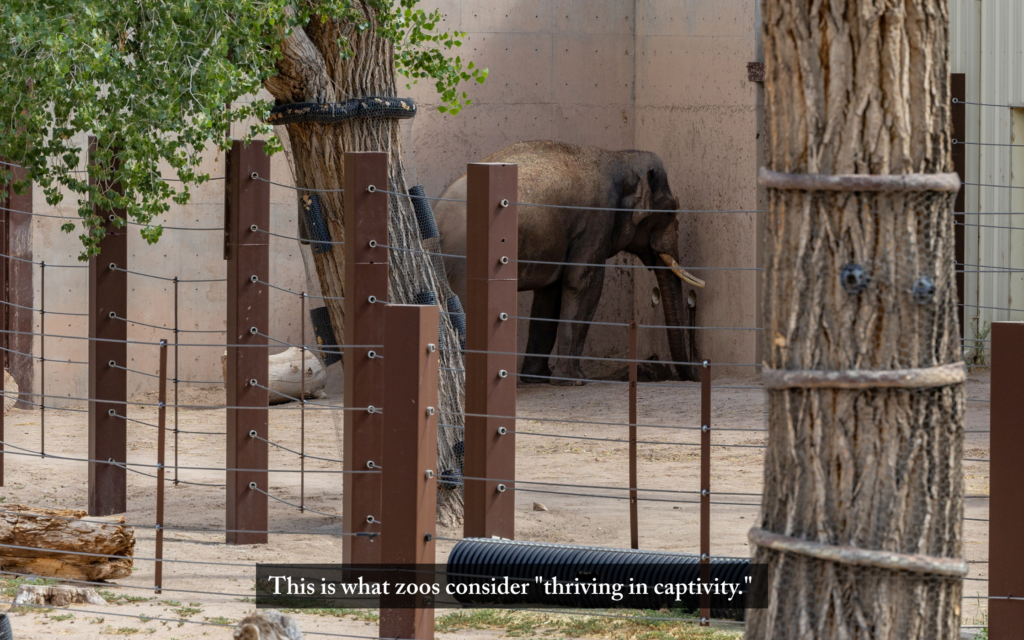
When exposed to stress-related hormones (e.g., cortisol) for prolonged periods, the hippocampus, which is involved with memory of facts and events, suffers severe physiological and micro-anatomical damage, including the death of neurons (nerve cells)—leading to impaired memory and compromised cognitive functions. Finally, when an animal is under chronic stress, the immune system is suppressed, making the animal more likely to get sick. Indeed, captive elephants are frequently immunocompromised and thus are more susceptible to a variety of stress-induced illnesses (e.g., tuberculosis, elephant endotheliotropic herpesvirus).
The captive environment is stressful, in part, because it is severely lacking in both quality and quantity for elephants and, by any measure, constitutes an impoverished environment. In this regard, it is important to understand that, at the most fundamental level, evolution has adapted the brain to interact with the environment, to process information coming in from the outside world, to integrate that information with what has already been stored in its intricate neural connections, and to act on the environment in some manner (i.e., behavior). Despite the best efforts of zoos, they simply cannot provide the kind of environment that elephants need to thrive. Elephants need a very large, ecologically diverse space (their natural habitat is as large as 10,000 km2), complex social interactions with other elephants, cognitive and sensory stimulation (rather than the monotony of decades in a barren, selfsame enclosure), and the freedom to forage on a large variety of plants. They need autonomy…they need to be able to make choices…they need to be actual elephants rather than just hollow, captive caricatures imprisoned for human entertainment.
In such impoverished conditions, decades of research indicate that, at every anatomical level examined, neural systems are impaired. At the molecular level, impoverished environments cause disruptions of neurotransmitter systems, decreases in nerve growth factor (involved with neuron survival), and changes in gene expression (needed to build proteins, the building blocks of cells)—all suggesting impaired neurogenesis, loss of neuroplasticity (the basis of learning and memory), weakened emotional resilience, and compromised cognitive performance. At the cellular level, impoverishment results in smaller capillary diameter, decreases in neuronal cell body size, fewer glial cells (support cells) per neuron, less complex dendritic branching, fewer and less efficient connections with other neurons. In other words, neurons do not receive the oxygen or structural/metabolic support and stimulation they need. These cellular changes, in turn, result in decreases in the thickness of cerebral cortex, which is crucial for most higher cognitive functions. In short, impoverishment interferes with the normal information processing of neurons and the overall functional health of the brain.
The neuroscientific evidence is irrefutable: impoverished environments contribute to brain damage. There are no real counterarguments to this conclusion. Zoo veterinarians typically know very little about neuroscience. Zoos, of course, claim otherwise. They argue that elephants are thriving and that they provide enrichment for elephants, which they do. However, zoo enrichment is nothing more than an ad hoc band-aid over the very problems caused by captivity. It is not a cure; it is an attempted treatment that is often applied repetitively and inconsistently (especially for an animal as cognitively complex as an elephant). There is also research confirming that a natural environment is more enriching than an artificial environment—zoos simply cannot replicate the natural environment for elephants.
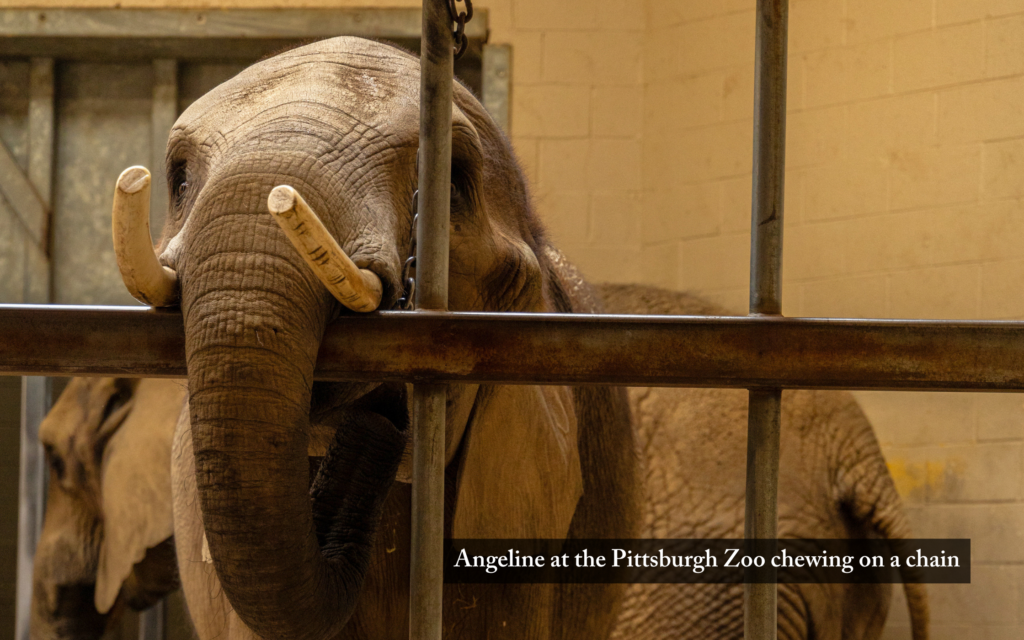
Other arguments that zoos use to justify keeping elephants are just as problematic. Zoos claim that having elephants in captivity is a form of conservation. It is not. Zoo populations are not self-sustaining, and thus constantly require importation of elephants. One does not need to have captive elephants in order to conserve elephants in the wild. Moreover, removing elephants from their natural habitat and placing them in zoos has negative environmental consequences because elephants are a keystone species who play a crucial functional role in their ecosystem. Finally, zoos claim they serve an educational purpose, although the research on this is quite questionable. What zoos do highlight in terms of education is the stark contrast between the complex, autonomous being that is a free-roaming elephant surrounded by family members in the wild, and the very damaged individual elephant that exists in captivity. No scientist who has studied free-roaming elephants believes that they should be held captive in zoos.
Given the social and cognitive abilities of elephants, it is simply impossible for them to have a meaningful existence in zoos. Insofar as captive elephants typically cannot be returned to their natural environment because they lack the skills to survive, the only realistic option is to release them to authentic sanctuaries. Unlike zoos, which are primarily designed for humans, true sanctuaries, even though they are still a form of captivity, are designed for the animals themselves. Sanctuaries provide a much larger, more natural space. In sanctuary, elephants have more freedom to be the cognitively sophisticated, socially complex creatures that they are. Rather than condemning their brains to suffer the insufferable impoverishment of a zoo enclosure, we should allow their magnificent brains the luxury to freely experience a more appropriate environment. Butterflies flying across grasslands. The cool mud of wetlands. Natural sounds (not roller coasters) and smells (not cotton candy). The unseen call of a relative in the distance. The freedom to choose one’s direction in life.
We should give them their rightful autonomy to contemplate what their existence means to them as opposed to forcing them to endure the tragedy of having an impoverished brain just so humans can be entertained. Indeed, let them contemplate.