Join the Nonhuman Rights Project’s Week of Action to #FreeThePittsburghElephants
Five African elephants held captive by the Pittsburgh Zoo have spent decades confined in conditions that cannot meet their complex physical, psychological, and social needs. From March 23–27, the Nonhuman Rights Project is hosting a Week of Action to raise awareness about their situation and urge the Zoo to release them to an accredited sanctuary.
Angeline, Savanna, Tasha, Victoria, and Zuri are autonomous, cognitively and emotionally complex beings whose unjust captivity violates their right to bodily liberty. In October 2025 the NhRP filed a habeas corpus lawsuit on their behalf seeking recognition of that right and their release to a sanctuary or rewilding program where they can live freely and with dignity.
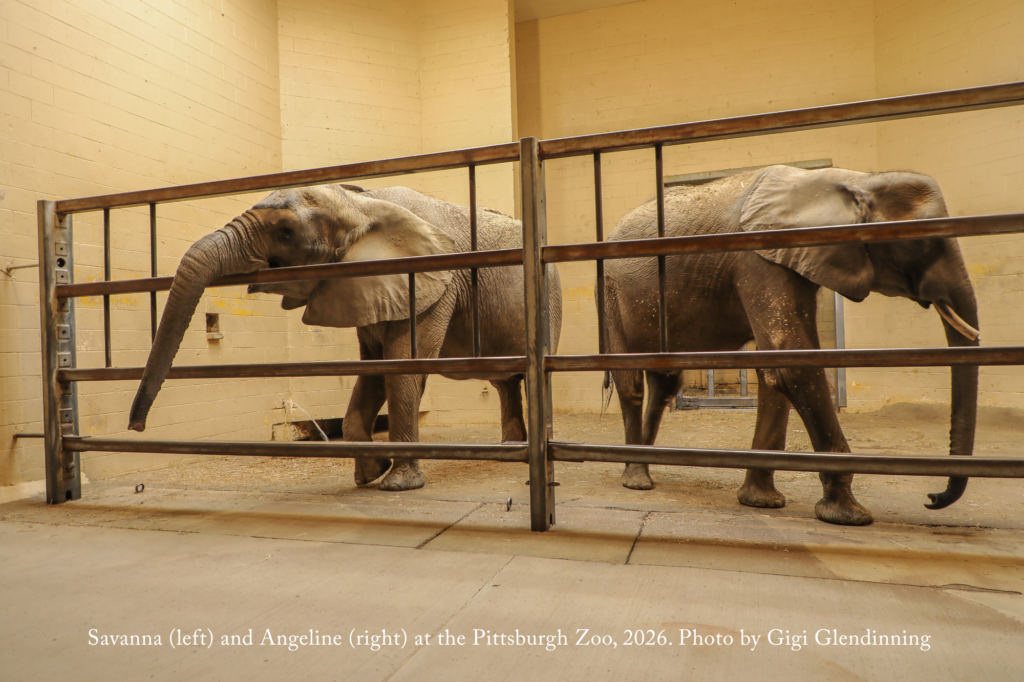
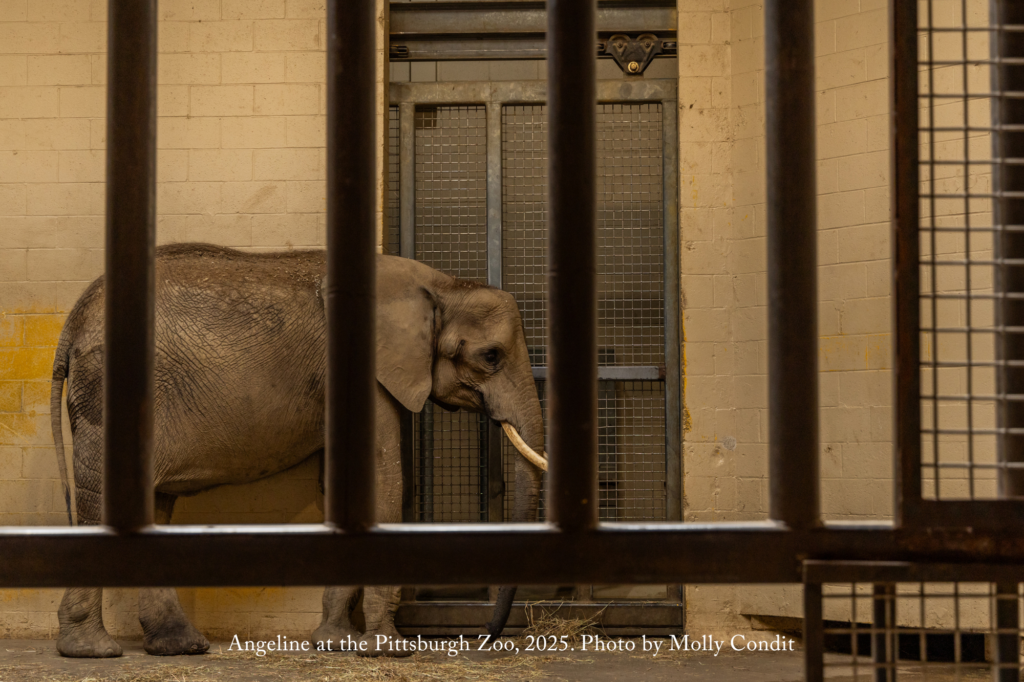
Scientific evidence shows that elephants suffer profoundly in captivity. In the wild, elephants travel many miles each day, forage across diverse landscapes, maintain intricate social relationships, and make constant decisions about their lives. At the Pittsburgh Zoo, however, the elephants have been confined to a small, barren enclosure and are frequently kept indoors on hard concrete surfaces—conditions that elephant experts say cannot meet their physical, psychological, or social needs.
In the Fall of 2025, two of the elephants, Victoria and Zuri, were transferred from the Pittsburgh Zoo to its offsite breeding facility, the International Conservation Center (ICC). This move highlights the role that captive elephants continue to play in the AZA’s grotesque breeding programs—which are designed to sustain zoo populations rather than prioritize the wellbeing and autonomy of the individual animals themselves.
Nothing about the captive breeding of elephants resembles conservation. The details and bleak statistics of it expose the profound ethical bankruptcy of the practice. Removing Victoria and Zuri’s parents from the wild did not help wild elephants. Forcing Savanna to produce members of the next generation of elephants who will suffer and die behind bars has not helped protect her species. From a conservation standpoint, all that’s been accomplished by captive breeding is an expansion of the population of exploited elephants to be confined by zoos for exhibition and profit.
Why Your Voice Matters
Savanna and Tasha were captured from the wild as infants and have spent more than four decades in captivity. Victoria and Zuri were separated from their mother when Zuri was only six years old, an event that would never occur in the wild where elephant families remain closely bonded for life. Angeline, born in 2008, has never experienced life outside captivity.
These elephants have already lost decades of their lives to exploitative captivity, but their future is not yet determined. Public awareness and engagement play an important role in advancing justice for individuals like Angeline, Savanna, Tasha, Victoria, and Zuri.
By participating in the NhRP’s Week of Action, you can help raise awareness about their plight and encourage the Pittsburgh Zoo to act in the elephants’ interests by releasing them to a sanctuary designed to meet their complex needs.
A growing number of institutions have already chosen this path, recognizing that elephants deserve more than a life of confinement to satisfy human curiosity. The Pittsburgh Zoo has the opportunity to do the same.
Why Sanctuary Is the Appropriate Alternative
Elephant sanctuaries accredited by the Global Federation of Animal Sanctuaries (GFAS) are designed to meet elephants’ complex physical, psychological, and social needs. These environments provide hundreds or thousands of acres of natural terrain and allow elephants to determine where they go, whom they spend time with, and how they live their lives.
In contrast to zoos, sanctuaries do not breed elephants or exhibit them for public entertainment. Instead, they prioritize the wellbeing and autonomy of the animals in their care.
Elephants transferred from zoos to sanctuaries often show significant improvements in mobility, behavior, and overall wellbeing once they are provided with the space and freedom that zoo captivity denies them.
Several zoos—including the Detroit Zoo, Louisville Zoo, and Zoo Knoxville—have already made the decision to close their elephant exhibits and relocate elephants to sanctuaries while continuing their conservation and education missions. The Pittsburgh Zoo can make the same compassionate choice.
Week of Action to Free the Pittsburgh Elephants
From March 23-27 we are asking people to take one key action every day to amplify the call for sanctuary for the Pittsburgh elephants. Each action takes only a minute or two. Together they help demonstrate growing public support for the elephants’ freedom.
Day 1: Contact the Pittsburgh Zoo’s CEO
Send a message to the Pittsburgh Zoo’s CEO urging him to release the elephants to a GFAS-accredited sanctuary.
Day 2: Share your support on social media
Use any of these pre-drafted social posts to create and share a personalized message explaining why these elephants deserve freedom. If you prefer to post something on your own, please tag the NhRP so we can see your post and thank you!
Day 3: Sign the local petition calling for the elephants’ freedom
This Change.org petition was published and circulated by advocates in Pennsylvania. It’s reached over 14,000 signatures already and continues to grow—demonstrating a growing public demand for the elephants’ freedom. Sign and share this petition calling on the Pittsburgh Zoo to send the elephants to sanctuary.
Day 4: Contact the Zoo’s Board Chair
Send a message to the Pittsburgh Zoo’s Board Chair urging her to make the compassionate decision to release the elephants to sanctuary.
Day 5: Share this Week of Action
Help expand awareness by reading and sharing this blog post which includes all of the Week of Action links!
Keep the Momentum Going
The fight to secure Angeline, Savanna, Tasha, Victoria, and Zuri’s freedom does not end with this Week of Action.
Every message sent, petition signed, and story shared helps bring greater attention to the lives of Angeline, Savanna, Tasha, Victoria, and Zuri and strengthens the growing public call for their release to sanctuary.
These elephants have already endured decades of confinement. But with continued public awareness and advocacy, their future could change.
By taking action and sharing their story, you are helping move us closer to a world in which elephants are recognized as individuals with the right liberty who should be given the freedom to enjoy all the richness of elephant life.
Together, we can help ensure that these elephants are given the chance to live in an environment that meets their needs, respects their autonomy, and allows them to reclaim their lives.