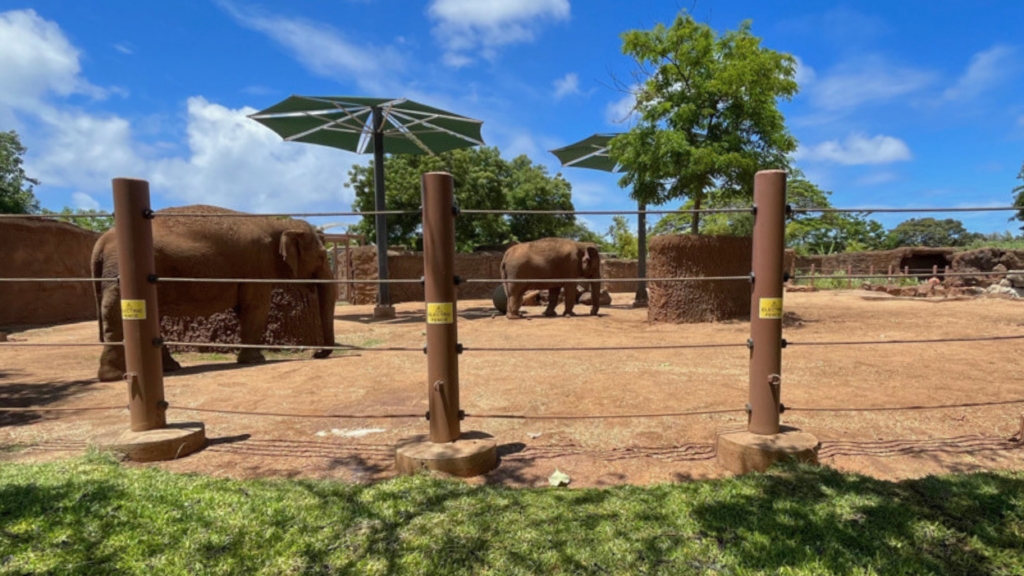
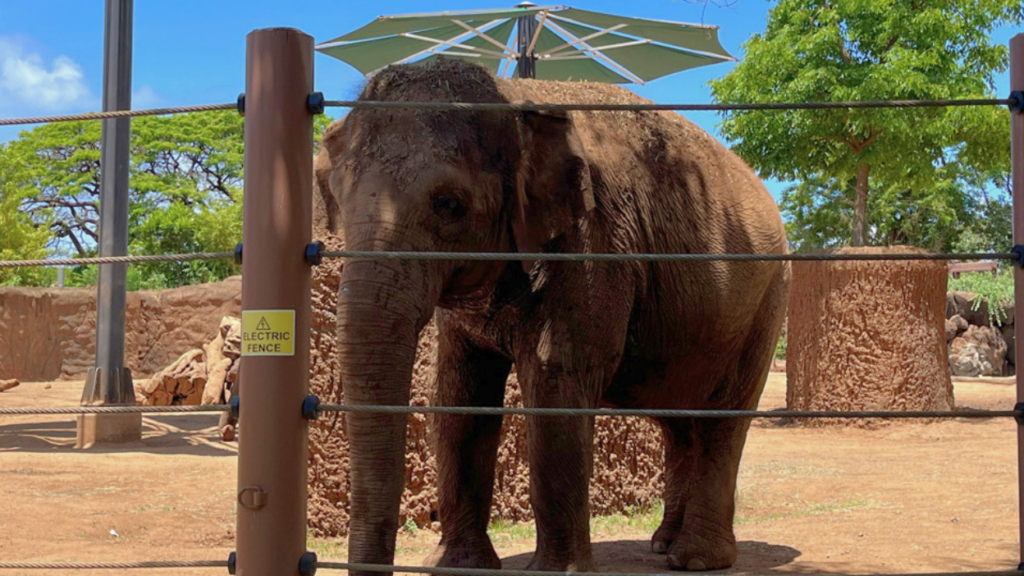
Earlier this year, the Nonhuman Rights Project’s habeas corpus petition on behalf of Mari and Vaigai—two, wild-born female Asian elephants held captive at the Honolulu Zoo since the 1980s and 1990s—was dismissed by the Hawai‘i Intermediate Court of Appeals (ICA). Last week, we asked the Supreme Court of Hawai‘i to review and overturn that decision—to allow the case to proceed as it should.
Left uncorrected, the ICA’s decision would halt the development of Hawai‘i common law at the very moment it is being invoked to address scientific advances in our understanding of nonhuman animals and their needs.
The United States Supreme Court has recognized: the “common law generally, adapts to changing scientific and factual circumstances.” – Am. Elec. Power Co., Inc. v. Connecticut, 564 U.S. 410, 423 (2011)
Here’s what you should know about our case for elephant rights in Hawai‘i—past, present, and future:
The Decision
The common law writ of habeas corpus—often called the “Great Writ”—is a legal mechanism for challenging unlawful confinement. Historically, the Great Writ has served as a critical and final safeguard of liberty, permitting detained individuals or their advocates to require the detainee’s custodian to justify the legality of the detention.
In October, 2023, we filed a habeas corpus petition asking the O‘ahu First Circuit Court to require the Honolulu Zoo to justify Mari and Vaigai’s confinement. Through collaboration with the world’s foremost elephant scientists, the petition presents scientific evidence establishing that Mari and Vaigai suffer immense physical and psychological harm because of their confinement. That science proves elephants have evolved to travel great distances and engage in rich social and individual activities that captivity cannot replicate. Restricting elephants of their ability to experience the world as nature intended. This is an essential component of why the confinement must be found illegal. We requested the Circuit Court consider transferring the elephants to an accredited sanctuary better suited to providing them with their evolutionary needs.
Rather than allowing the case to proceed to that threshold justification, the Circuit Court dismissed our petition, and in January 2026, the ICA affirmed the Circuit Court’s decision to dismiss our case. It held that the Great Writ is categorically unavailable to Mari and Vaigai because elephants are not “persons” within the meaning of Hawai‘i’s habeas statute. However, the courts wrongly equated the legal term “person” with its colloquial definition instead of its legal definition.
The term “person” in the habeas corpus statute functions as a placeholder for any individual who may invoke the writ’s protections. In other words, a legal person is a nonbiological category. It is not synonymous with being human. The relevant question is not whether elephants meet the definition of “person,” but whether Mari and Vaigai may invoke the Great Writ to challenge their confinement because of how detrimental the confinement is to their well-being. This question can only be resolved by allowing our petition to proceed to an evidentiary hearing, which would require the Honolulu Zoo to justify the elephants’ confinement under the common law.
The Error
The ICA’s decision hinges on a fundamental mistake. It treats the Great Writ as a rigid, statutory remedy rather than its intended purpose: a common law safeguard of liberty that courts have the authority and duty to develop. Last Friday, we filed our certiorari application, asking the Hawai‘i Supreme Court to review the ICA’s decision. In our application, we explain why this distinction matters.
First, the Hawai‘i Constitution protects habeas corpus as a fundamental right. That protection preserves the Great Writ as it exists at common law—meaning the legislature may regulate the procedure for invoking the writ but it cannot eliminate or narrow the writ’s scope to any class of individuals, human or otherwise.
Second, throughout history, it has been the courts (not legislatures) that have determined who may invoke the Great Writ’s protections. Habeas corpus has long been used to test the legality of confinement for individuals whose legal rights were not yet fully recognized. Habeas corpus is, at its core, a mechanism for asking whether the law should recognize a liberty interest, not a mechanism limited only to individuals already possessing said interest.
Habeas corpus is, at its core, a mechanism for asking whether the law should recognize a liberty interest, not a mechanism limited only to individuals already possessing said interest.
Third, the ICA’s reliance on the plain meaning of the word “person” (excluding elephants from the writ’s protections) ignores the central question our case presents. In the habeas context, “person” is not a biological label but a legal status that follows from the recognition of a legal right. In other words, if an individual is granted a legal right, they necessarily become a legal person. Legal personhood denotes possessing at least one right. If Mari and Vaigai are recognized as possessing a right to liberty, then they are necessarily legal “persons” for purposes of habeas corpus relief.
The argument for recognizing Mari and Vaigai’s right to liberty is straightforward: Autonomy (which the scientific evidence shows Mari and Vaigai possess) underlies the common law right to liberty, which habeas corpus safeguards. Therefore, confinement that prevents Mari and Vaigai from engaging in normal, autonomous behavior is a violation of their right to liberty under the common law.
By treating the question of whether elephants can invoke the Great Writ’s protections as already settled, the ICA effectively foreclosed the very inquiry habeas corpus exists to address.
The Stakes
The NhRP’s case on behalf of Mari and Vaigai extends beyond these two elephants. It asks whether the law can respond to evolving knowledge, social norms, and scientific discovery. Science has established that elephants are autonomous, cognitively complex individuals who form deep social bonds, plan for the future, and experience the world in ways that are profoundly similar to humans and fundamentally incompatible with confinement in zoo environments.
The common law has always evolved in response to new understandings of who is entitled to protection. Habeas corpus has played a central role in that evolution. The question now before the Hawai‘i Supreme Court is whether that tradition will continue.
Simply, will Hawai‘i courts retain their role as stewards of the common law, shaping the scope of the Great Writ and fundamental rights? Or will the courts defer entirely to statute, even where those statutory frameworks fail to account for new scientific knowledge and evolving conceptions of justice?
Next Steps
Now that we have asked the Hawai‘i Supreme Court to review the ICA’s decision, it’s up to the Court to decide if habeas corpus remains a common law remedy. It is also up to the Supreme Court to decide if a novel habeas corpus petition establishing a plausible claim of unlawful confinement can still proceed to an evidentiary hearing, allowing the underlying liberty claims (i.e., whether Mari and Vaigai’s confinement is lawful under the common law) to be considered on a full record.
Take action to support our case on behalf of Mari and Vaigai:
- Submit our Action Alert to email the Honolulu Zoo Director urging her to release Mari and Vaigai to an accredited elephant sanctuary.
- Donate to support our continued litigation to secure fundamental legal rights for Mari and Vaigai.